
The Guest Rootfs
The custom initramfs, the overlayfs root, and the initramfs-style switch_root that emberd-init performs as PID 1.
When a sandbox boots, the kernel runs emberd's own initramfs, a tiny cpio archive
whose /init is a statically-linked emberd-init. As PID 1, that binary builds
the real root filesystem and then serves the control plane.
The initramfs
rootfs/build.sh produces ~/firecracker-verify/emberd-initramfs.cpio:
CGO_ENABLED=0 GOOS=linux GOARCH=amd64 \
  go build -trimpath -ldflags="-s -w" -o "$STAGE/init" ./cmd/emberd-init
mkdir -p "$STAGE"/{proc,sys,dev,newroot,tmp}   # mountpoints emberd-init needs
( cd "$STAGE" && find . | cpio --create --format=newc ) > emberd-initramfs.cpio
Building with CGO_ENABLED=0 means the binary is fully static, so the initramfs
carries no libc, no shell, nothing but /init and a handful of empty
mountpoints (~2.5 MiB total). Everything else comes from the language pack.
The overlay root
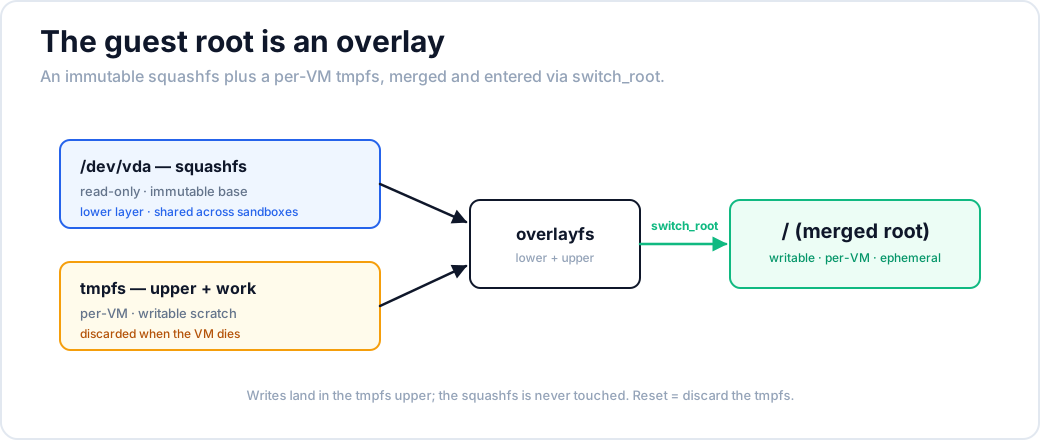
The architecture wants a writable root without mutating the immutable base image,
so emberd-init assembles an overlayfs:
- lower: the language-pack squashfs, mounted read-only.
- upper + work: a fresh tmpfs (per-VM, lives in RAM).
- merged: the overlay of the two; this becomes the new root.
Writes land in the tmpfs upper; the squashfs is never touched and its pages are shareable across sandboxes. Reset semantics are trivial: the tmpfs dies with the VM.
The boot sequence
bootstrapPID1() runs only when os.Getpid() == 1 (so host-side unit tests of
the same binary skip it):
- Mount
procon/proc, devtmpfs on/dev(this is what makes/dev/vdaappear), andsysfson/sys, all inside the initramfs. - Mount the squashfs (
/dev/vda) read-only at/lower. - Mount a tmpfs at
/overlay; createupper/andwork/on it. mount -t overlaywithlowerdir=/lower,upperdir=/overlay/upper,workdir=/overlay/workat/newroot.MS_MOVE/proc,/dev,/sysinto/newroot(carrying their subtrees).- switch_root into
/newroot. - Set a default
PATHandHOME(PID 1 starts with an empty environment, sopython3isn't resolvable until this is done). - Read
emberd.interpreter=from/proc/cmdline(see language packs). - Start the child reaper (a
SIGCHLDhandler). As PID 1,emberd-initinherits any process a workload double-forks; the reaperwait4s them so they don't leak as zombies, while still lettingrunExeccollect the interpreter's own exit code. - Serve the vsock control plane.
Why switch_root and not pivot_root?
pivot_root(2) is rejected on an initramfs (EINVAL). So emberd uses the
busybox switch_root technique instead:
syscall.Chdir(newRoot)            // cd /newroot
syscall.Mount(".", "/", "", syscall.MS_MOVE, "")  // move merged root onto /
syscall.Chroot(".")               // chroot into it
syscall.Chdir("/")
Moving the /proc, /dev, /sys submounts into /newroot before the final
MS_MOVE means they ride along when the whole subtree relocates to /.
You can confirm it worked from inside a running sandbox; /proc/mounts shows:
overlay / overlay rw,relatime,lowerdir=/lower,upperdir=/overlay/upper,workdir=/overlay/work 0 0/ is the overlay, and writes anywhere (e.g. /root, /etc via copy-up) succeed.
Kernel requirements
The guest kernel needs SQUASHFS, OVERLAY_FS, DEVTMPFS, TMPFS, and
VIRTIO_BLK (plus the vsock options from the control-plane page). The Firecracker
CI kernel has all of them built in, verified by extracting its embedded config,
which is why emberd boots on the stock kernel with no rebuild.
The kernel boot args still include panic=1, so if emberd-init ever exits or
the bootstrap fails, the guest panics and the VM dies, which is the correct
outcome for a sandbox whose agent is gone. The VM stays alive purely because PID
1 (emberd-init) blocks forever in its vsock accept loop; nothing on the host
needs to hold the VMM's stdin open (it's wired to /dev/null).