
The vsock Control Plane
The host↔guest wire protocol, the Firecracker hybrid-vsock handshake, and the raw-fd transport in the guest.
All host↔guest traffic (exec requests and their results) travels over a
virtio-vsock device, never an IP network. This keeps the "no network"
guarantee honest: a v0.1 sandbox has no NIC at all, yet the daemon can still talk
to it. The protocol lives in pkg/proto, the one package shared by the daemon and
emberd-init.
The wire format
Every message is a 4-byte big-endian length prefix followed by that many bytes
of JSON. One ExecRequest host→guest, one ExecResult guest→host, per
connection. Messages are capped at 64 MiB to bound allocations against a corrupt
or hostile length prefix.
type ExecRequest struct {
	Code      string `json:"code"`
	Stdin     string `json:"stdin,omitempty"`
	TimeoutMs int    `json:"timeout_ms,omitempty"`
}

type ExecResult struct {
	Stdout     string `json:"stdout"`
	Stderr     string `json:"stderr"`
	ExitCode   int    `json:"exit_code"`
	DurationMs int    `json:"duration_ms"`
	Error      string `json:"error,omitempty"` // set only on launch failure
}
JSON over a hand-rolled length prefix (rather than gRPC or protobuf) keeps the
dependency surface tiny, stays debuggable, and matches the REST API's existing
JSON shapes. WriteMessage/ReadMessage implement the framing.
The hybrid-vsock handshake
Firecracker exposes vsock to the host as a Unix domain socket (the "hybrid vsock" model). To reach a port inside the guest, the host:
- Connects to the host-side Unix socket (
<workdir>/<id>/vsock.sock). - Sends
CONNECT <port>\n. - Reads back an
OK <hostport>\nacknowledgement line. - Treats everything after that line as the raw guest stream.
proto.DialGuest does exactly this. One subtlety: it reads the ack one byte at a
time rather than with a buffered reader, so it can't accidentally consume bytes
of the guest's data stream that arrive right after the newline. It also bounds the
dial (5s) and the handshake (10s) so a missing guest can't hang the caller.
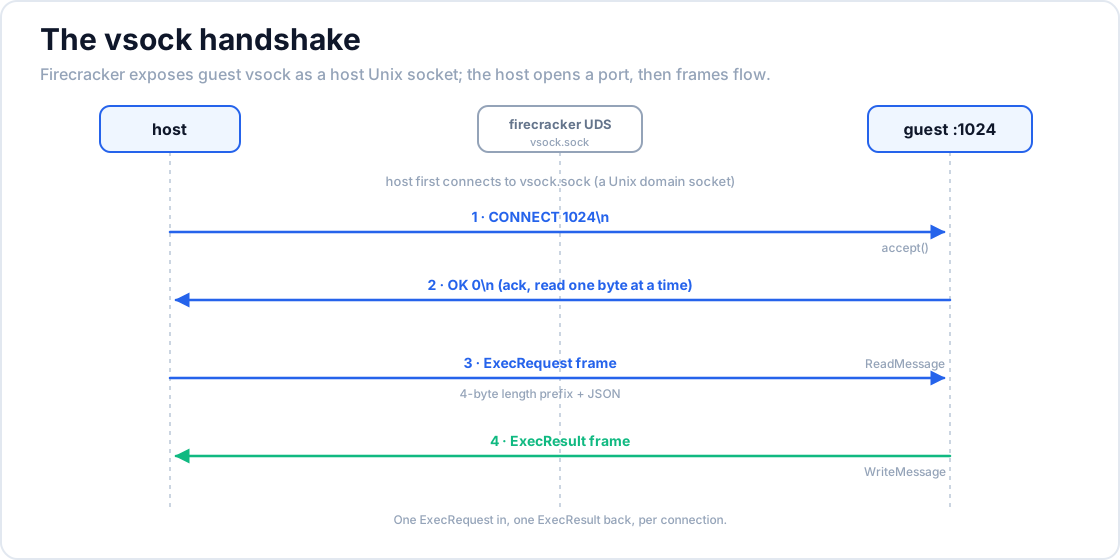
The guest binds vsock port 1024 (proto.GuestPort).
The guest listener (and why not net.Conn)
emberd-init opens an AF_VSOCK socket with golang.org/x/sys/unix, binds
VMADDR_CID_ANY:1024, and accepts connections. Each accepted connection is
handled by reading one ExecRequest, running it, and writing one ExecResult.
The catch: Go's net.FileConn rejects vsock file descriptors. Wrapping an
accepted AF_VSOCK fd fails with getsockname: address family not supported. So
the guest reads and writes the raw fd directly through a tiny adapter:
type vsockConn struct{ fd int }

func (c *vsockConn) Read(p []byte) (int, error)  { /* unix.Read, retry EINTR, map 0→EOF */ }
func (c *vsockConn) Write(p []byte) (int, error) { /* unix.Write in a full-write loop */ }
func (c *vsockConn) Close() error                { return unix.Close(c.fd) }
vsockConn satisfies io.Reader/io.Writer, which is all proto.ReadMessage/
WriteMessage need. The host side, by contrast, is a normal Unix socket, so it
uses net.Dial as usual.
This was found the honest way: the first end-to-end attempt logged
wrap vsock conn: ... address family not supported on every connection until
the raw-fd adapter replaced net.FileConn.
Kernel requirements
The guest kernel must have CONFIG_VSOCKETS and CONFIG_VIRTIO_VSOCKETS. The
Firecracker CI kernel (vmlinux-6.1.155) has both built in, which is why emberd
runs on the stock artifacts with no custom kernel.