
Introduction
What emberd is, what it isn't, and how the pieces fit together.
emberd is a Firecracker-based sandboxing runtime for executing AI-agent tool calls inside isolated microVMs. It's a local-first, open-source take on E2B / Modal-style sandboxes: create a sandbox, run code inside it, collect the output, then destroy it, all in real hardware-virtualized isolation.
# Create a sandbox (boots a microVM), run code, tear it down.
curl -X POST localhost:7777/sandboxes -d '{"language_pack":"python"}'
# → {"id":"sb_a1b2c3d4e5f6"}

curl -X POST localhost:7777/sandboxes/sb_a1b2c3d4e5f6/exec -d '{"code":"print(6*7)"}'
# → {"stdout":"42\n","stderr":"","exit_code":0,"duration_ms":13}

curl -X DELETE localhost:7777/sandboxes/sb_a1b2c3d4e5f6
# → 204 No Content
What emberd is
- A single-machine daemon for short-lived, isolated code execution.
- A KVM / Firecracker microVM runtime, not a container wrapper.
- A small HTTP API for sandbox create, exec, and destroy.
- A foundation for fast startup via Firecracker snapshot restore (planned).
What emberd is not
- Not a Docker replacement. Containers share a kernel with the host; emberd uses KVM virtualization, so the guest runs its own kernel.
- Not a fleet orchestrator or serverless platform: it is one daemon on one box.
- Not tied to Python long-term, though Python is the first language pack.
- Not designed for persistent storage or cross-sandbox communication.
Why microVMs?
A container shares the host kernel; a kernel bug or a container escape is a host
compromise. A Firecracker microVM gives each sandbox its own kernel behind a KVM
boundary, the same primitive AWS Lambda, Fly Machines, Modal, and E2B use to run
untrusted code. The trade is that it's Linux + KVM only and needs a separate
firecracker binary, which is fine for a runtime that is Linux-only by intent.
emberd is pre-alpha, but the full loop works end to end today: create boots a real microVM, exec runs code inside it over a vsock control plane, and delete tears it down. See the Roadmap for what's still ahead (hardening, snapshot restore, purpose-built language-pack images).
The 30-second mental model
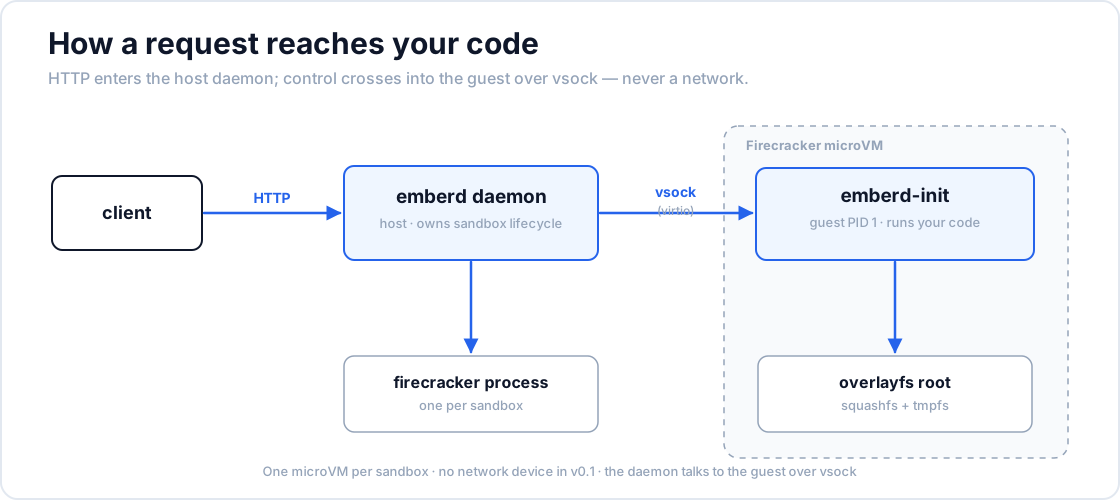
- The daemon (
emberd) owns the HTTP API and the lifecycle of each microVM. emberd-initis PID 1 inside the guest; it serves a tiny control protocol over vsock and runs submitted code.- There is no network device inside a sandbox in v0.1; even the control channel is vsock, not IP.
Where to go next
Getting started
Install the prerequisites, build the binaries and initramfs, run your first sandbox.
Architecture
The components, the request lifecycle, and the runtime model.
Concepts
Deep dives: lifecycle, the vsock control plane, the guest rootfs, language packs.
API reference
The three HTTP endpoints and their request/response shapes.